WordPress core
Security fixes within daysWe install small releases that close security holes promptly. However, we test big version jumps against your plugins first and install them once nothing conflicts.

Website Maintenance
Website maintenance that keeps Westwood business sites patched, backed up, scanned and quickly edited. As a result, no plugin release takes down your booking form, and no stale hours from last term stay up once the calendar turns.
Westwood rarely stands still. Students turn over every year, Village storefronts change hands, and even fixtures move: the Fox Village Theatre and the Bruin both closed when their leases ran out in July 2024, yet people still search for “westwood village theater showtimes”. As a result, old information keeps circulating long after it stops being true. A business site needs someone checking that it describes this term, not last year.
Still more change is on the calendar. Metro’s D Line extension plans Westwood/UCLA and Westwood/VA Hospital stations, with the last section expected in 2027, and suggestions such as “westwood ucla station” already appear. When those stations open, directions on many local sites will need a new line. Hours shift around academic breaks and commencement, the Thursday market changes foot traffic on Broxton, while events at Broxton Plaza fill the Village on particular days.
Behind the words, the software also needs attention. Separate teams maintain WordPress core, the theme and each plugin, and they release fixes on their own schedules. If you skip a few months of updates, the pieces start to disagree. For example, an appointment request never reaches your inbox, a menu page renders badly on Android, or an add-on its author gave up on turns into the weak spot an automated attack looks for. Regular website maintenance finds that sort of fault while it is still small.
Search demand
Taken from Google’s US suggestions in October 2026. Although none is about websites, they all share a date: people expect the answer to be true this week, so they hold your own site to that standard too.
A customer usually finds a website emergency weeks after the inquiries quietly stopped, and the repair then costs more than the care would have. Regular upkeep moves that effort earlier, where it is cheap and predictable. Westwood sites also get an hours routine: before each academic break, holiday or event day, we check that your site and your Google profile say the same thing, and remove any notice once it has served its purpose.
Hidden problems
None of them shows up on a quick look at your home page.
Summer or exam-week hours still showing in October, or a holiday closure that never came down. Visitors either find you shut or conclude that nobody looks after the site.
The thank-you message appears, but the inquiry lands in spam or the mail server rejects it. Sending form mail through a proper delivery service, and testing it each month, catches this.
Notes that mention a neighbor who has since closed, a parking arrangement that has changed, or nothing about transit. Instead, directions should describe the block as it stands today.
The hosting login sits with a past manager or a long-gone developer, while renewal reminders land in a mailbox no one checks. So we trace each account and transfer it to your business.
Attackers look for plugins that no longer receive updates, then add spam pages that never appear in your menu. Rankings then sink, and no one can see why.
What we look after
Each part wears out at its own pace, so we look after them on separate calendars.
We install small releases that close security holes promptly. However, we test big version jumps against your plugins first and install them once nothing conflicts.
Most broken pages and most break-ins start with an add-on. So we keep the list short and delete anything that has stopped earning its place.
Hosts drop support for aging PHP versions on a timetable of their own. Before your site moves up, we run a copy on the newer version, look for errors, and switch only after you say yes.
If the domain or the security certificate lapses, visitors see an error and email may stop as well. We track each renewal date and the card or account that pays for it.
The work
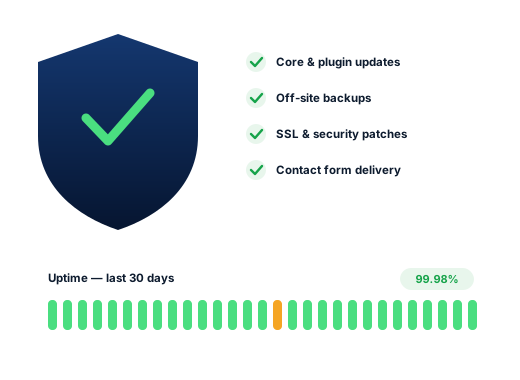
Software brought current on a set day each month. A backup comes first; afterward we load the pages that bring in business on a phone and check them.
Copies of the database and files stored with a separate provider, and a test restore now and then to prove they would really work.
Regular malware scans, a cap on failed sign-ins, a periodic look at who still holds admin rights, and same-week patches whenever someone announces a flaw in one of your plugins.
If the site stops responding, an alert reaches us within minutes, usually before anyone at your business has noticed.
We submit your contact and booking forms ourselves and confirm that the message turns up in your inbox.
Send a line about fall hours, a new dish, a hire or a temporary closure and we publish it, then take it down on the date you give.
Done carefully
Ground rules we keep for every Westwood client, written down so you can hold us to them.
You keep the keys: hosting, domain and the top administrator account. We sign in with a user of our own, and deleting it shuts us out at once.
Routine care costs nothing beyond your monthly plan. However, a site left unattended for years, or one that attackers have broken into, needs a separate cleanup first; we quote that job after an inspection, before any work begins.
Ask us about your business
How we work
Four steps, used for a boba counter and a dental practice alike.
An audit of your site and listing, with rankings checked from the Village, North Village and points along Wilshire.
Out of everything locals type, we choose the searches worth chasing and match each to one focused page.
Listing, site, content and citation work, starting with whatever should bring customers in soonest.
A short note on leads, rankings and next steps, written for an owner rather than an analyst.
Questions
Upkeep adds nothing to your bill, because Starter ($300), Growth ($500) and Pro ($700) all include it, monthly in US dollars. However, long-abandoned or infected sites first need a single repair job, which we price after inspecting them.
Yes. Send us the dates and the new hours and we update the site, then remind you to set matching special hours on your Google profile. When the break ends, the regular hours go back up.
Usually. First we find out what it runs on, who controls the domain and hosting, which plugins it uses and what is out of date. Then you get a plan and a price for any fixes, and we move the accounts into your name.
If you ask, yes. When the Westwood/UCLA station opens, we can add a line on walking from it to your door and check that your contact page and Google profile say the same. Until then we treat the opening date as planned, not certain.
Quite possibly, since odd pages in search results, visitors bounced to unknown sites or a red browser warning all point that way. We quote the repair as its own job: we strip out the injected code, shut the hole it used, then request a fresh review from Google.
No. You pay your host yourself, under an account in your name, so the server stays firmly yours. If you need one, we can suggest a dependable provider.
Further reading
More on this subject for Westwood owners who want the detail.
Each service can be hired on its own; plenty of owners start with one.
Customers in each field search with their own vocabulary, so each page has its own research behind it.
A free snapshot of your rankings from North Village down to the Wilshire Corridor, the names ahead of you and the changes likely to help first.
Request my free audit