
Speed Optimization

Website speed optimization in Westwood, Los Angeles

Speed optimization for Westwood businesses whose customers search on phones, often over crowded campus or hospital wifi or on mobile data between stops. We measure pages the way those visitors really load them.

  • Core Web Vitals
  • Mobile first
  • Image weight
  • Third-party scripts
  • Caching
A cyclist riding past a glass-fronted building at golden hour, dry hills in the distance

Why speed optimization matters for searches made on the move

Inside the Village, Westwood gets around on foot, by scooter and by bus, whereas along Wilshire it drives. Either way the search happens on a phone. For example, someone types “food near ucla ronald reagan hospital” in a waiting room, or “westwood village apartments ucla” on the way to class. Then they tap the first likely result and give it a few seconds. If your page is still a blank white screen, they go back and tap the next one.

However, connections here are not always kind to heavy pages. A full lecture hall, a busy hospital lobby or a packed bus can all mean a slow, shared signal. Sites that seem fine on office broadband can stall in those conditions, especially when the first thing to load is a large photo, a video or a booking widget pulling scripts from several other servers.

Google is also watching. Part of how it judges page experience comes from loading data gathered on real Chrome visits, so a slow site loses twice: visitors give up, and Google sees less reason to show it. Still, speed optimization rarely means stripping your site bare. Instead, it means sending each visitor only what they need, in the right order and at the right size.

  • 2.5 s loading target for the largest element (LCP)
  • 200 ms response target after a tap (INP)
  • 0.1 layout shift score that counts as stable (CLS)
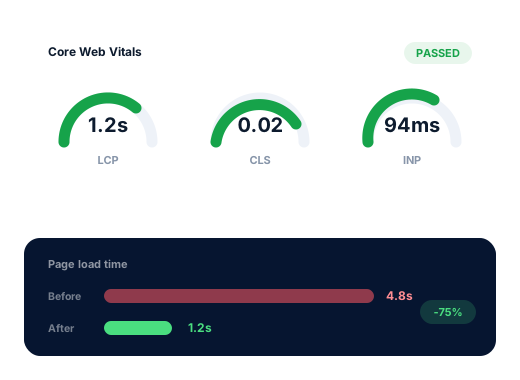
Speed optimization artwork: three green gauges next to a progress bar close to complete

Search demand

Where speed optimization pays: searches that land on slow pages

Google suggestions gathered with US settings in October 2026. Nobody searches for site speed in Westwood, but these phone searches lead straight to photo galleries, floor plans and menus, the slowest pages a local business usually has.

Search term Intent Why it matters
wilshire corridor condos for sale High Listing pages with dozens of large photos and floor plans, so the first image must arrive quickly.
westwood village apartments ucla High Students flick through building after building, so they skip any gallery that stalls.
food near ucla ronald reagan hospital High Typed inside a hospital, often on a congested connection, so a light menu page wins.
brunch westwood village High Menus and food photos judged on a phone before anyone walks over.
hotels westwood village los angeles Research Visitors planning ahead compare room galleries side by side before booking.
persian rugs westwood ca Research Large, detailed product photos need careful compression so they stay sharp.
westwood restaurants near me High A quick decision made on the sidewalk, so seconds matter.

Same photos, a fraction of the load

You do not need to remove the images that sell your rooms, dishes or listings. A lead photo cut to its on-screen size, saved as WebP or AVIF and marked as a priority download can look identical yet arrive much sooner, while everything below the fold waits until the visitor scrolls. We begin with the pages that draw the most visits, usually the menu, the floor plans or the gallery. Then we judge success by Google’s field data from real visitors rather than a lab score.

Where time is lost

What speed optimization usually finds on a Westwood business site

A slow site seldom has a single cause, so these five often turn up side by side.

  1. 01

    Full-size photos in small spaces

    A picture straight off a camera or a phone can be many times larger than the space it fills on screen. So resizing and converting it removes most of the weight with no visible loss.

  2. 02

    Menus and price lists saved as images or PDFs

    Especially common with restaurants, cafés and salons. They load slowly, search engines cannot read them as text, and they are awkward to zoom. In contrast, a plain text menu is lighter and easier to update.

  3. 03

    Booking and ordering widgets on every page

    Third-party booking, delivery and chat tools often pull large scripts into the whole site. So loading them only on the pages that need them, or only after a tap, frees up everything else.

  4. 04

    Autoplay video at the top

    A background clip can hold up the rest of the page on mobile data. A still image with a play button is usually the better trade.

  5. 05

    A server that answers slowly

    A sluggish host delays everything that follows, however well you build the page itself. Caching softens the problem; occasionally moving to a better host is the only lasting cure.

Google’s three measures

Core Web Vitals, the three scores speed optimization targets

Google takes these numbers from Chrome users who actually opened your pages in the last 28 days. For each measure, the page passes only if three visits in every four land inside the limit.

01

Largest Contentful Paint (LCP)

Loading

This marks when the biggest item in view, usually a hero photo or a headline block, finishes appearing. Google’s good threshold is 2.5 seconds. Pages with large photos or video at the top therefore tend to fail here first.

02

Interaction to Next Paint (INP)

Responsiveness

The pause between a tap, on a menu button, a calendar or “Order”, and the screen visibly responding. Google wants 200 milliseconds or less. Mostly, third-party booking tools, chat bubbles and layers of tracking tags slow it down.

03

Cumulative Layout Shift (CLS)

Stability

Content sliding about as late items load, which is why a thumb meant for “Directions” sometimes lands on “Call”. Google treats anything under 0.1 as good. Setting aside space for photos, banners and map embeds before they load stops the jumping.

The work

How a speed optimization project runs

01

A baseline first

Before any change, we log the phone scores, Chrome field figures and total download size of your most visited pages.

02

Images resized and converted

Every photo exported at its on-screen width, compressed with care, delivered as WebP or AVIF where supported, and held back until a visitor scrolls near it.

03

Menus and lists turned into text

Image or PDF menus, price lists and timetables rebuilt as real web content that loads fast and shows up in search.

04

Scripts delayed or removed

We make chat bubbles, review feeds, booking embeds and analytics wait until the page responds, then uninstall plugins that sit idle.

05

Caching tuned to the host

Page, browser and server caching configured for your hosting, plus a content delivery network if it helps.

06

Measured again a month later

A check on launch day and another after four weeks, once Google’s field data reflects the changes.

Done carefully

Honest limits of speed optimization

Ground rules we keep for every Westwood client, written down so you can hold us to them.

In fairness
Speed earns you a look. Whether that look becomes a booking still depends on your reviews, your prices and the words on the page.

Page experience is a modest part of how Google ranks, and we will not tell you otherwise. When your important pages meet the thresholds, we stop and recommend where the next hour would do more good, perhaps a clearer service page or a better-kept Business Profile. Speed optimization is a one-time job, priced after an audit.

Tested on
Phones over mobile data
Proof
Before and after figures
Done when
Field data passes all three
Ask us about your business
An owner and an advisor leaning over a printed chart report on a shop counter, ceramic pieces on the shelves behind
  • Real visitors come before a lab number.
  • Google and your visitors always get the same page.
  • Your booking or ordering tool stays unless you agree.
  • We fix the site you have before suggesting a new one.

How we work

From first audit to monthly report

Four steps, used for a boba counter and a dental practice alike.

  1. 01

    Survey the ground

    An audit of your site and listing, with rankings checked from the Village, North Village and points along Wilshire.

  2. 02

    Pick the phrases

    Out of everything locals type, we choose the searches worth chasing and match each to one focused page.

  3. 03

    Make the changes

    Listing, site, content and citation work, starting with whatever should bring customers in soonest.

  4. 04

    Report every month

    A short note on leads, rankings and next steps, written for an owner rather than an analyst.

Questions

Speed optimization questions from Westwood owners

Can we measure our site’s speed without you?

Two easy ways. Enter your web address in PageSpeed Insights, Google’s free tool, and read the mobile results drawn from real visits. Then turn off wifi on your own phone, walk to the end of the block, and load the page a new customer would see first.

Will we need fewer photos?

Probably not, because weight usually comes from file size and delivery rather than the number of photos. When each one fits its space and loads only as it scrolls into view, a long gallery can stay long.

Does speed improve rankings?

A little, and mostly as a tiebreaker between pages that are otherwise close. The bigger payoff shows in what visitors do, because people actually read a page that appears at once, and that reading brings more calls, bookings and walk-ins.

We use an online ordering or booking tool. Will speed optimization break it?

No. We test the tool before and after each change. Often the fix is simply to load its scripts only on the pages that use it, or only once someone taps “Book” or “Order”. That keeps it working while lightening every other page.

How long does it take?

Expect a week or two of hands-on work for a typical small site. The confirmation takes longer: Google’s field report averages the past 28 days of visits, so the improvement shows in full about a month after the changes go live.

What does speed work cost?

A single price, agreed once the audit has shown what is slowing you down. After that, keeping pages quick falls under the ongoing care in each monthly plan: Starter $300, Growth $500, Pro $700, in US dollars.

Further reading

From the blog

More on this subject for Westwood owners who want the detail.

Related services

Each service can be hired on its own; plenty of owners start with one.

How easy are you to find from Westwood Village today?

A free snapshot of your rankings from North Village down to the Wilshire Corridor, the names ahead of you and the changes likely to help first.

Request my free audit